9.2 Example: Inversion with Retrograde
In music, retrogade means playing backwards, beginning with the last note and ending with the first note of the original composition. However, the time allotted by parameters such as » «, »
«, » «, etc. can’t be inverted so intuitively; the example of a recording played backwards is not musical retrograde.
We will work with the form  Simple
 . Here we can see a similarity with the inversion of
  and the symmetry of retrograde:
  , where
  is the total »size« of the piece, measured in
  . If, for example, we have a measure in common time (divided in four),
  , and if
  (a note that begins on
  in its retrograde the same note will begin on
  .
.
But what will happen when we have 2 notes with  and
and  , separated by
  ? That is,
  1 has, for example,
  and
and 
 begins at
  . If we apply the symmetry
  , we will have

that, in our example, is

. Then the retrograde of


begins exactly
Onsetdistance 
before the retrograde of


. However, if the duration of

2 is longer than
Onsetdistance (for example, if it is 1.5) then
 Offset
will not be finished when

begins.
Therefore, we include the parameter  when we define a retrograde symmetry, and we work in the two dimensional space
  . If we take two events
  , first we must apply
  to the parameter
  of both notes, i.e.,
  and
and  . Consider the duration of

 . Then we have
  . However, this transformation is intermediate, because we want to avoid overlaps. That’s why we take into account the parameter
  to obtain
  and
and  , that is
  and
and  . This way, the overlap from
  to
to  is completely avoided, because the retrograde of
 ends at
  and
and  1 begins at
  . We define retrograde as
  , that is,
![[ ] (s,0) - 1 -1 Ks = e . 0 1 .](../graphic/Co2147x.gif)
It is clear that in this example we are not considering the parameter

which is also subject to retrograde. Finally, the inversion with retrograde, as used in serial dodecafonic music, involves three parameters, that is,

,

, and

. Then we have:
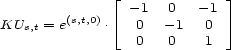
and if the original

,

, and

values are

, then: