|
an abstract, or symbolic performer playing a symbolic instrument. In contrast, the physical gesture curve describes the movements of a virtual performer who resides in a geometric 3D space and thus is intended to behave like a real performer, playing a real instrument. In addition, physical gesture curves can be used for sound synthesis of physically modelled instruments, for instance by using the velocity or acceleration of the performer’s movements as sound synthesis parameters. This article deals with the design of a symbolic gesture space and the algorithmic construction of parametric symbolic gesture curves in such a space. The symbolic gesture space will be well suited for representation of instruments similar to pianos, and the resulting parametric curves can already be taken as a first approximation of a corresponding physical gesture curve. We shall also see that some MIDI concepts are related to our approach of creating a symbolic gesture space. The construction of physical gesture curves is still the subject of ongoing research, but the article will show that successful creation of symbolic curves is crucial for their physical counterparts. The next section will cover relevant previous and related work in the area, then the basic concepts of gesture spaces with particular focus on symbolic gesture spaces will be given. Following that, we will deal in detail with the systematic construction of symbolic gesture curves. The results section will present examples that resulted from the current implementation of the theory. 2 Related WorkThroughout this article, we shall not deal with performance theory in general, but will provide basic concepts, where necessary. Refer to Mazzo la (2002b) for details. An in-depth coverage of ongoing research of RUBATO with respect to computer-aided musical performance and the new PerformanceRubette is given in Müller (2002). In computer music and music informatics, musical gestures have mainly been used in the domain of controlling musical instruments. Refer to Wanderley and Battier (2000) for an extensive investigation on this subject; in particular Wanderley and Cadoz (2000) discusses several definitions of the term ‘gesture’ in this context. For a coverage of semiotic aspects of music and gestures refer to Mazzola (1999) or Henrotte (1992). In the field of computer animation and computer graphics, Cassell et al. (2001) have presented a toolkit which can generate appropriate and synchronised non-verbal behaviours and synthesised speech from given input typed text. The output then can be sent to an animation system, which for example renders a talking avatar. For a broad discussion of animation of humans refer to Badler et al. (1993), for recent developments to Faloutsos et al. (2001).
3 Gesture Spaces
Performance theory, as implemented in the former PerformanceRubette, defined a score space |
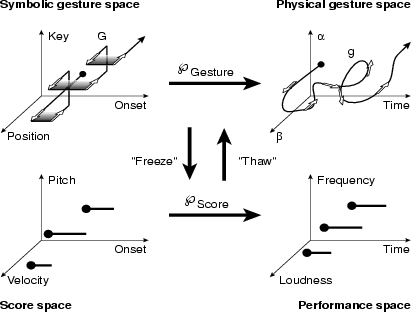
 and the physical gesture curve
  , their inter-relationships, and the relationship to the corresponding instrument spaces.
 , a performance space
  and a performance transformation