Step 3: Determine a complete list of all the elements of a discrete structure. In a complete list of a discrete structure each element of this structure occurs exactly once. Step 4: Generate the objects of a discrete structure uniformly at random. In other words we apply an algorithm which generates each object of a discrete structure with exactly the same probability. Especially in the case when the objects of a discrete structure are themselves classes of (equivalent) objects, then we ask that the algorithm hits each class with the same probability, even if not all the classes are of the same size. In general, step 3 is the most ambitious task, it needs a lot of computing power, computing time and memory. For that reason, when the set of all elements of a discrete structure is too hard to be completely determined it is useful and makes sense to consider step 4. This approach allows to generate a huge variety of different unprejudiced objects of a discrete structure. These sets of examples can be very useful for checking certain hypotheses on them and afterwards for trying to prove the valid ones.
For example, let us have a short look at the classification of unlabelled graphs on  vertices:
- Step 1:
- There are
 graphs on
  vertices.
 - Step 2:
- There exists exactly one graph with
 edges, with
  edge, with
  edges or with
  edges; two graphs with
  or
or  edges; three graphs with
  edges.
 - Step 3:
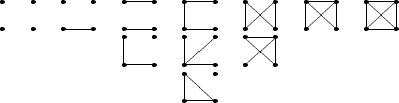
- The unlabelled graphs on
 vertices are given in figure 1.
In this example step 4 is trivial, whence it is omitted.
As was already mentioned, the standard tool for classification of discrete structures is the notion of group actions. A detailed introduction to combinatorics under finite group actions can be found in Kerber (1991, 1999).
A multiplicative group  with neutral element
  acts (from the left) on a set
  if there exists a mapping

 vertices.