|
As a consequence we get Theorem 3. If 
Finally, as the last notion under group actions, we introduce the set of all fixed points of 
Let Theorem 4. (Cauchy Frobenius Lemma) The number of orbits under a finite group action 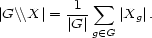
The most important applications of classification under group actions can be described as symmetry types of mappings between two sets. Group actions  in the following way: 

The direct product 
|


 which is denoted by
  be a finite group action. The main tool for determining the number of different orbits is the Cauchy Frobenius Lemma. Sometimes it is misleadingly called Burnside’s lemma. It can be found in many text books for combinatorics or algebra.


 and
and  on the domain
  and range
  induce group actions on
  acts on
  by
by  acts on
  by
by  acts on
  by
by