such that for all

- the set
 can be obtained from
  by a translation of
  ,
, - there is only the identity translation which maps
 to
to  ,
, - the set of differences in
 generates
  , i.e.
We prefer to write a canon  as a set of its subsets
  . Two canons
  and
and  are called isomorphic if
  and if there exists a translation
  of
of  and a permutation
  in the symmetric group
  such that
  for
for  . Then obviously
  applied to
  yields
  .
.
Here we present some results from Fripertinger (2002). The cyclic group  acts on the set of all functions from
  to
to  by
by

When writing the elements  as vectors
  , using the natural order of the elements of
  , the set
  is totally ordered by the lexicographical order. As the canonical representative of the orbit
  we choose the function
  such that
  for all
  .
.
A function  (or the corresponding vector
  ) is called acyclic if
  consists of
  different objects. The canonical representative of the orbit of an acyclic function is called a Lyndon word.
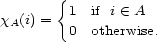
As usual, we identify each subset  of
of  with its characteristic function
  given by
Following the ideas of Fripertinger (2002) and the notion of Andreatta et al. (2001), a canon can be described as a pair  , where
  is the inner and
  the outer rhythm of the canon. In other words, the rhythm of one voice is described by
  and the distribution of the different voices is described by
  , i.e. the onsets of all the voices of the canon determined by
  are
are  for
for  . In the present situation,
  is a Lyndon word of length
  over the alphabet
  , and
, and  is a
is a  -subset of
  . But not each pair
  describes a canon. More precisely we have:
An application of the principle of inclusion and exclusion allows to determine the number of non-isomorphic canons.






