which are non-Hajós groups. He proved that each pair

computed along the following algorithm is a regular complementary canon of maximal category.
Let  be a non-Hajós group, whence
  as described in Corollary 10. Vuza presents an algorithm for constructing two aperiodic subsets
  and
and  of
of  such that
  ,
,  , and
, and  . In order to construct
  , for
, for  let
let  be a nonperiodic set of representatives of
  modulo its subgroup
  . Then set
  . In order to determine
  , for
, for  choose
  and let


Choose a set  of representatives of
  modulo
  , let
, let  , and put
  .
.
Consequently, both  or
or  can serve as the inner or outer rhythm of a regular complementary canon of maximal category. Moreover, as we saw there is some freedom for constructing these two sets, and each of these two sets can be constructed independently from the other one. Vuza also proves that when the pair
  satisfies
  , then also
  ,
,  have this property for all
  .
.
A regular complementary canon of maximal category which can be constructed by Vuza’s algorithm will be called Vuza constructible canon. The following table shows the numbers of isomorphism classes of Vuza constructible canons for some values of  : (With
  ,
,  , and
, and  we denote the number of possibilities to determine essentially different aperiodic sets
  and aperiodic sets
  , and non-isomorphic canons
  by using Vuza’s algorithm.)
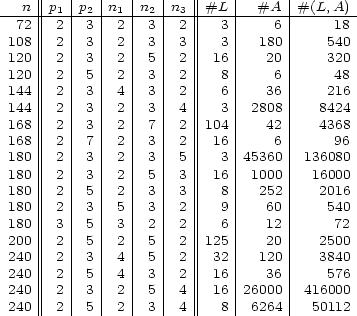
| Table 3: | Number of isomorphism classes of Vuza ¿constructible canons in  |
|
In order to determine the complete number of isomorphism classes of Vuza constructible canons in  for given
  , we have to determine all possibilities to decompose
  as in Corollary 10 and sum up the number of isomorphism classes of Vuza constructible canons for these parameters. For instance, for
  we have
  isomorphism classes of canons with
  , and by interchanging
  and
and  also
also  isomorphism classes of canons with
  , whence
  isomorphism classes of Vuza constructible canons.