|
concept of Time-Point System. We argue that there is a possibility to better understand the developments of integral serialism by »transgressing the (geographical) boundaries«, to seriously quote the title of Sokal’s famous hoax, and by analysing how some ideas could have freely moved from Europe to USA and vice-versa. The French theorist and composer Olivier Messiaen has probably played a crucial role for what concerns the European assimilation of some Babbittian original intuitions. A piece like Mode de valeurs et d’intensités, written during the period Messiaen spent teaching composition at Tanglewood, is clearly influenced by his contacts with Babbitt’s integral serialism. Musicologists usually stress the influence of this very particular piece on composers like P. Boulez and K. Stockhausen, but they seems to forget to pay attention to Babbitt’s possible role in Messiaen’s combinatorial attitude.6
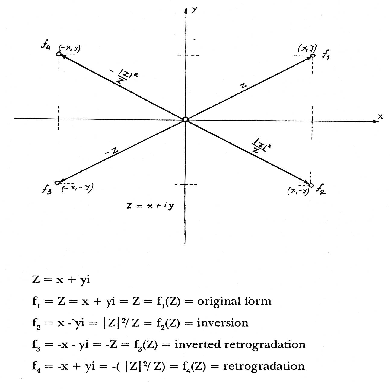
 . It may be realised geometrically as the group of symmetries of the rectangle (or, equivalently, of the rhombus or ellipse). . It may be realised geometrically as the group of symmetries of the rectangle (or, equivalently, of the rhombus or ellipse). Musically it represents the theoretical basis of Arnold Schoenberg’s »Dodecaphonic System«, as pointed out in many writings by Milton Babbitt, Anatol Vieru and Iannis Xenakis. Xenakis discusses this relation in such a way (Xenakis, 1991, p. 169). Let  be the complex plane which is naturally isomorphic to the two dimensional Euclidean space be the complex plane which is naturally isomorphic to the two dimensional Euclidean space  . A musical sound of pitch . A musical sound of pitch  and time attack and time attack  can be represented by a point can be represented by a point  . . The four elements of  can be seen as the following operations on can be seen as the following operations on  : :  These correspond to the four forms of a twelve-tone row which are respectively, the original (or »prime«) form, the inversion, the inverted retrogradation (or retrograde inversion) and the retrogradation (See Fig. 1).
Note that  is generated by the operations is generated by the operations  and and  , i.e. , i.e.  More generally one can show that the dihedral group  is generated by the complex mappings given by is generated by the complex mappings given by  This is a simple formalization of Xenakis’s original intuition that the four symmetries of the twelve-tone system are but a special case of a more general compositional |