|
Hajós’ Theorem is also called the »Second main theorem for finite abelian groups« (Rédei, 1967) and it has been shown that there is a logical duality between it and another important result in group theory, known as Frobenius-Stickenberger’s Theorem. Hajós’ Theorem can be formulated in an equivalent way by using the concept of periodic subset of a groupe, i.e. a subset  such that there exists an element such that there exists an element  in G (other than the identity element) such that in G (other than the identity element) such that  . It is not difficult to see that Hajós’ main Theorem is equivalent to the statement that an integer . It is not difficult to see that Hajós’ main Theorem is equivalent to the statement that an integer  exists such that exists such that  is periodic. An expression in which, as I have shown before, a group is periodic. An expression in which, as I have shown before, a group  has been factored in a direct sum (or, equivalently, using multiplicative notation, in a direct product of has been factored in a direct sum (or, equivalently, using multiplicative notation, in a direct product of  subsets) is often called a subsets) is often called a  -Hajós factorisation. I will use the expression »Hajós factorisation« in the case where -Hajós factorisation. I will use the expression »Hajós factorisation« in the case where  =2, which is the most interesting aspect of the Theory that we will discuss. =2, which is the most interesting aspect of the Theory that we will discuss. A group  is said to possess the is said to possess the  -Hajós property 14 -Hajós property 14
 -Hajós group) if in every -Hajós group) if in every  -Hajós factorisation at least one factor is periodic. In a similar way to that which was noted before, a Hajós group is a group with the 2-Hajós property. Historically the first research related to the Hajós property were attempts to study the Hajós abelian finite groups. However the distinction between Hajós groups and groups with the -Hajós factorisation at least one factor is periodic. In a similar way to that which was noted before, a Hajós group is a group with the 2-Hajós property. Historically the first research related to the Hajós property were attempts to study the Hajós abelian finite groups. However the distinction between Hajós groups and groups with the  -Hajós property ( -Hajós property ( ) is very important, for there are results which apply to the case ) is very important, for there are results which apply to the case  only, as shown in Fuchs (1964). Whilst it is true that results of musical interest have only been obtained, for the moment, for only, as shown in Fuchs (1964). Whilst it is true that results of musical interest have only been obtained, for the moment, for  , I will summarise all the more general results, because I think that this could help us to see new interesting applications in the musical domain. , I will summarise all the more general results, because I think that this could help us to see new interesting applications in the musical domain. 3 List of Hajós groupsFirstly we give the complete list of groups which have the Hajós-property. We also provide a short account for the case of
|
 -Hajós groups
  with some particular assumption for what concerns the cardinality of every factor.
  be the short notation for the direct product
  and let
  be distinct primes,
  integer.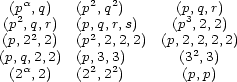
 , with
  and where
  are distinct prime numbers,
  integer.