|
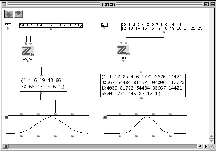
rhythmic world and the pitch domain. By means of the action of a (commutative) group  on a on a   -set -set  , the collection of orbits determined by the action of , the collection of orbits determined by the action of  on the set of all subsets of on the set of all subsets of  , which are also called »modal classes« or »transposition classes«) has the algebraic structure of a commutative semigroup with a unit element. , which are also called »modal classes« or »transposition classes«) has the algebraic structure of a commutative semigroup with a unit element. Different notations have been used by Vuza in the more than 10 years that separate the original collection of papers on the mathematical aspects of Vieru’s Modal Theory (Vuza, 1982-83) from the most recent article on Supplementary Sets and Rhythmic Canons (Vuza, 1991-93). In summarising the principal results of Vuza’s rhythmic model we shall use concepts and definitions given in Vuza (1985), Vuza (1988) and Vuza (1991-93), and attempt to make uniform the notation of the latter. By definition, a periodic rhythm is a periodic and locally finite subset  of of  . This means: . This means: This second property differs slightly from that of Vuza (1985) and Vuza (1986). The least positive rational number satisfying the first condition is called the period of   is a commutative semigroup with unit element under the following law (called »composition« and indicated with +): is a commutative semigroup with unit element under the following law (called »composition« and indicated with +): ![M + N = [M + N]](../graphic/Co3378x.gif) ![[M ]](../graphic/Co3379x.gif) signifies the translation class of a given subset signifies the translation class of a given subset  of of  . . Taking  we obtain the 352 »modal classes« (including the null class) which have been originally studied by Zalewski in Zalewski (1972). Figure 2 shows the symmetric distribution of transposition classes of chords in we obtain the 352 »modal classes« (including the null class) which have been originally studied by Zalewski in Zalewski (1972). Figure 2 shows the symmetric distribution of transposition classes of chords in  and and  . .
Note that, using dihedral symmetry, as usually applied in American Set-Theory, the number of equivalent classes of chords in a given well-tempered division of the |
 such that
  .
.  .
. whereas the greatest positive rational number dividing all differences
  with
with  is called the
  .
.  . More formally one can consider the action of
  on the set of periodic rhythms as defined by the map
  and call a
  under this action. Following Vuza’s notation I shall indicate with
 ![[R]](../graphic/Co3364x.gif) the rhythmic class of a given rhythm
the rhythmic class of a given rhythm  and with
  the collection of all rhythmic classes. More generally, I shall indicate with
  the set of translation classes of a given group
  , i.e. the set of equivalence classes determined by the relation
  between subsets of
  which are the translate of each other through an element
  in
in  (see
(see  and
and  of
of  are defined in the following way: