|
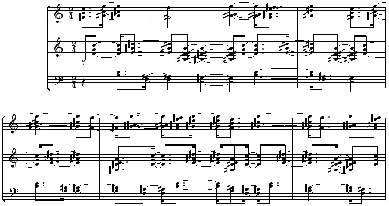
Making use of the standard intervallic notation for a rhythmic class, we find that the rhythmic classes associated with the couple of non periodic supplementary sets  and and  are, respectively: are, respectively: ![S = [12,12,3,12,12,57] R = [2,2,2,4,1,9,16,4,2,4,10,9,7,2,2,2,4,26]](../graphic/Co3475x.gif)  of its voices, of its voices,  obviously is equal to obviously is equal to  . We observe that the power . We observe that the power  alone is far from being the most important parameter. For example, take the smallest cyclic group alone is far from being the most important parameter. For example, take the smallest cyclic group  that does not have the Hajós property. This case has been taken as an example of remarquable number by F. Le Lionnais (Lionnais, 1989) who quoted the following decomposition of that does not have the Hajós property. This case has been taken as an example of remarquable number by F. Le Lionnais (Lionnais, 1989) who quoted the following decomposition of  in two non-periodic subsets by L. Fuchs (Fuchs, 1960, p. 316): in two non-periodic subsets by L. Fuchs (Fuchs, 1960, p. 316):   are isomorphically associated with the following rhythmic classes are isomorphically associated with the following rhythmic classes ![S = [8,8,2,8,8,38] R = [1,4,1,6,13,4,7,6,6,1,4,19]](../graphic/Co3484x.gif)  and that in both cases the set and that in both cases the set  has a stronger symmetrical character than the set has a stronger symmetrical character than the set  . . Looking at the metric class  of all these regular complementary canons of maximal category, we observe that it has a property which could be called of »partial non invertibility«. Writing of all these regular complementary canons of maximal category, we observe that it has a property which could be called of »partial non invertibility«. Writing  as as ![[s1,s2,...,sn]](../graphic/Co3490x.gif) , either , either ![[s1,s2,...,sn-1]](../graphic/Co3491x.gif) or or ![[s2,s3,...,sn]](../graphic/Co3492x.gif) is a non- invertible rhythmic class (in the sense of Messiaen). By definition we say that the rhythmic class is a non- invertible rhythmic class (in the sense of Messiaen). By definition we say that the rhythmic class ![[s1,s2,...,sn]](../graphic/Co3493x.gif) is non invertible if it coincides with its inverse is non invertible if it coincides with its inverse ![[sn,sn-1,...,s1]](../graphic/Co3494x.gif) . The sense of the adjective »partial« in the definition of the previous property is clearly intuitive: . The sense of the adjective »partial« in the definition of the previous property is clearly intuitive:  is non invertible with the exception of the first or the last temporal interval. The fact that every metric class of a given regular complementary canon of maximal category has the property of »partial non invertibility« seems not to be a direct consequence of the theory here under discussion. It seems appropriate, therefore, to class this fact as a conjecture which, because of its analogy with some of Messiaen’s ideas, has been called the »M-Conjecture« (Andreatta, 1997). Moreover, a comparison between this theory and some of Messiaen’s music- theoretical ideas, such as those contained in Messiaen’s recent Traité (Messiaen, 1992) shows that the problem of formalisation of canons was very central to the French composer. An interesting example is given by the piece Harawi (part no. 7, Adieu). is non invertible with the exception of the first or the last temporal interval. The fact that every metric class of a given regular complementary canon of maximal category has the property of »partial non invertibility« seems not to be a direct consequence of the theory here under discussion. It seems appropriate, therefore, to class this fact as a conjecture which, because of its analogy with some of Messiaen’s ideas, has been called the »M-Conjecture« (Andreatta, 1997). Moreover, a comparison between this theory and some of Messiaen’s music- theoretical ideas, such as those contained in Messiaen’s recent Traité (Messiaen, 1992) shows that the problem of formalisation of canons was very central to the French composer. An interesting example is given by the piece Harawi (part no. 7, Adieu). From a rhythmic point of view, the previous example realises a canon in three voices, each voice being the concatenation of three non-retrogradable rhythms, as it is shown in figure 7: In Messiaen’s words, this global musical structure is an example of an »organised chaos« (Messiaen, 1992, p. 105), for the attacks of the three voices seem to be almost complementary. This is only partially true, as it is clear from the following representation of the canon |