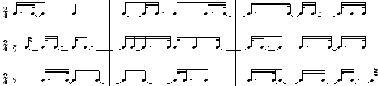
anges, des saints, du chant des oiseaux. The only difference concerns the minimal division of the rhythm, which is now equal to a 32th note. Figure 9 shows the formal rhythmic structure of this new canon.
4 Conclusion
There are basically two possible answers to the question we asked at the beginning of this essay. Talking about mathematical groups, as talking about symmetry or other algebraic concepts in music, could have either a mathematical or a musical sense. In the first case, mathematicians may consider, for example, that some group-theoretical problems do have something interesting from a purely mathematical perspective. Despite Olivier Revault d’Allones’ already quoted pessimistic position, stressing the fact that the sciences, and mathematics in particular, »can bring infinitely more services ![[...]](../graphic/Co3500x.gif) to music than music can bring to the scientific knowledge«, there are cases for which music could be the starting point for the mathematical research itself. But in order to give to the initial question a complete answer we also have to take into account the (sometimes unexpected) musical ramifications of a mathematical research.
to music than music can bring to the scientific knowledge«, there are cases for which music could be the starting point for the mathematical research itself. But in order to give to the initial question a complete answer we also have to take into account the (sometimes unexpected) musical ramifications of a mathematical research.
Since Vuza’s original paper on tiling canons and my personal contribution in revising such mathematical structures with the help of the concept of Hajós groups and with some more general MaMu-Theoretical constructions18
| | I would like to express my thanks to Guerino Mazzola for stressing the necessity of revising most of the algebraic concepts introduced by Vieru and Vuza within the framework of the local/global theory. The generalisation of Vieru and Vuza’s modal theory to more sophisticated modules will enable the theorist/composer to work not only in the pitch or rhythmic domain but in both domains, including a parametrised space for intensities and other relevant musical properties. |
many people have been fascinated by these remarquable structures. The implementation realised in collaboration with Carlos Agon and Thomas Noll made available the complete list Vuza-Canons for any given non-Hajós group

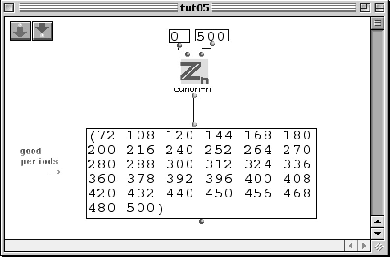
. Figure 10 gives the order

of non-Hajós cyclic groups with

.
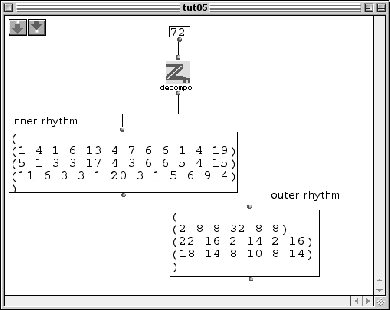
Figure 11 shows all possible
inner and
outer rhytms for Vuza-Canons of period 72.
The case of the construction of special tiling rhythmic canons suggests that there are musical problems whose mathematical ramifications could be sometimes very unexpected.
19| | Emmanuel Amiot stresses the fact that these music-theoretical constructions could help mathematicians to approach some still open mathematical conjectures (Amiot, 2004). Another famous example of a musical result which appeared to be connected with an old mathematical conjecture is the so-called Babbitt’s Theorem of Hexachord, stating that two complementary hexachords do have the same interval content. The first knot-theoretical proof of this theorem by Ralph Fox was published as a new way of solving Waring’s problem, one of the old standing problems in number theory (see Babbitt, 1987, p. 105). |