Thus  is tiling
  , i.e.
  is a disjoint union of translates
  of
of  . Without stress on
  , we will simply say that
  tiles. This definition is already quite restrictive, as it forbids two different voices to play on the same beat (which happens often in musical canons such as the Musical Offering). The restriction of a common pulsation however, which allows to rescale to integers, is not as stringent as it seems as proved in (Lagarias and Wang, 1996).
An example of a rhythmic canon is given by  , the inner rhythm, and
  , the outer rhythm of the canon. We also use a second description writing the beats of one voice from left to right in one line, where 1’s stand for beats and 0’s stand for silences, and different voices in consecutive lines vertically aligned.
110011000
110011000
110011000
110011000
110011000 |
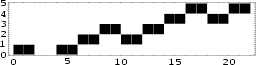
Figure 1 shows a graphic representation of the same canon, with a black square at every beat and time flowing from left to right.
A further equivalent definition for finite  , very useful as we will see, uses polynomials. It is customary to introduce a generating function
  as follows: Let
  and similar for
  . As a translate of rhythmic motif
  is obtained by multiplying the associated polynomial
  by a
by a  , it is easily seen that
Up to a change of the time origin, it can be assumed that both sets  and
and  begin with 0 (i.e.
  for the associated polynomials). This we will assume throughout the paper. Such polynomials are called 0-1 polynomials and may be viewed as elements of several rings (see section 4.2). The limitation on the finiteness of
  and
and  will be discussed below (see Theorem 2 and Theorem 3).
The number of non zero coefficients in  will be exactly the product of the number of non zero coefficients in
  and
and  . These numbers are the