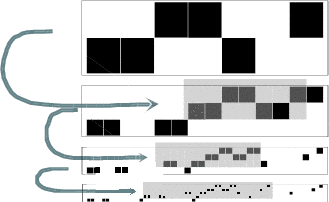
2.1 Why Infinite Tiles are Less InterestingWe show in this paragraph why the restriction to finite motives is necessary, not only from obvious musical reasons, but also on the grounds of mathematical interest. The program listed in the Appendix demonstrates a Theorem (Swenson, 1974) which shows that the most general tilings of Theorem 2 Any direct sum of two finite sets (of integers) can be extended to an infinite direct sum decomposition of If The next figure shows a few steps of such an extension. The gray region at each step outlines the preceding canon.
This result vindicates our choice of studying only finite motives, but also means that a given finite canon can be extended to span arbitrary large periods of time (though only by increasing the length of the motif and the number of voices). Simulations do seem to grow in size quite fast, but with suitable truncating it might help build some pretty musical (or pictural) compositions. 2.2 RepetitionThe musically most appealing of all these results is the following one: any canon repeats itself. Theorem 3 Any tiling of The proof in Hajós (1950) is obscure, Nicolass Govert de Bruijn had one around the same time, but it was not published, and Tijdeman (1995, p. 265)’s is a bit |
 can literally contain anything: