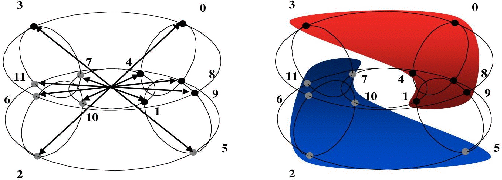
of complementary intervals is rather large (distance is calculated according to the
»cityblock
«-metrics on the torus

).
Finally, the markedness of the dissonances with respect to the consonances is reflected by an algebraic fact: The set  is multiplicatively closed while the set
  is not. The intervals of 0 = »prime/octave« 1 = »fifth«, 4 = »major third« and 9 = »minor third«, which may close a musical phrase are even idempotent, i.e.
  ,
,  ,
,  ,
,  . In other words, dissonances are in the need of consonances, but not vice versa. The properties of autocomplementarity and of markedness are the points of departure for further investigations. Mazzola reconstructs consonant progressions (first species) under the assumption that even consonant progressions exemplify the principle of contrast. His model contains the postulate that the two consonances of a >sanctioned< progression may be polarized by a minimal deformation of the Fux dichotomy. Surpringly, this model recovers the Fuxian rules, especially it confirms the forbidden »open parallels of fifths« as well as the »Tritonus rules«. The interpretation of markedness is discussed in (Noll and Brand, 2004), section 4.1 (this volume).
2.3 Transformation and Voice Leading Parsimony
In 19th century harmony one often finds chord sequences exemplifying a principle of maximal parsimony of voice leading. Each hexatonic triadic cycle is an example for this. Among the 24 major- and minor triads in the twelve-tone system there are 4 cycles of length six consisting of minimal voice-leading neighbours. E.g., bars 586 - 618 towards the end of the first movement of Schubert’s Piano-Trio in  (D929) are organized along the following cycle:

The very fact that each triad has two (triadic) minimal voice leading neighbours is commonly known. By chromatically lowering the third of a major triad we reach the minor triad with the same root. By lowering the root of a major triad we reach