|
with arbitrary Also it enables to make greater canons from small ones, which has interesting abstract as well as practical consequences: computerized tools for such transformations of canons are currently under development.
2.6 Equirepartition’From de Bruijn (1955) to Tijdeman (1995) there was some concern about equirepartition, that is to say equiprobability of all residues of a set (or sum of sets) modulo some  Start from   . Indeed a reverse is true : . Indeed a reverse is true : Theorem 7 A finite subset
|
 each time.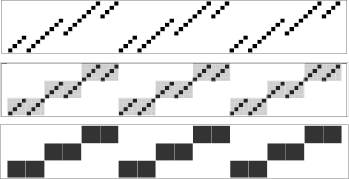
 .’ Now in the case of a canon, if
  can be written
  it means that
  is a complete set of residues modulo
  , or in other words there is equirepartition modulo
  ; in polynomials this is expressed by:
  , a trivial tile, and randomly add multiples of
  to each the exponents above, e.g. get


