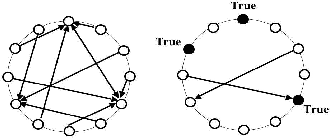
of dissonance< with respect to {0, 4, 10 } to each tone. Figure 3 shows how to make these assignments in the case  . The five truth values are obtained as follows. A tone  gets the truth value -
 - if the identity
 maps it into {0, 4, 10}, i.e. if it is an element of {0, 4, 10}, maps it into {0, 4, 10}, i.e. if it is an element of {0, 4, 10}, -
 - if it is mapped into {0, 4, 10} by both tone perspectives
 and and  but not by the the identity but not by the the identity  (the tone (the tone  is the only one with this truth value), is the only one with this truth value), -
 - if it is mapped into {0, 4, 10} by
 but not by but not by  , (four tones have this truth value, namely , (four tones have this truth value, namely  ), ), -
 - if it is mapped into {0, 4, 10} by
 but not by but not by  , which is the case for , which is the case for  and and  , , -
 - if it is mapped into {0, 4, 10} neither by
 nor by nor by  , which is the case for , which is the case for  and and  . .
On the basis of this list we may look at each individual chord of the piece. The segmentation into harmonic units its rather straightforward. It is useful to consider half-bars as the smallest harmonic segments, sometimes full-bar segments are appropriate. Figure 4 gives a representative list of all situations occurring in the piece. The examples are notationally displayed with respect to the concrete transpositions but rotated into the standard picture of  . .
|
 . It will contribute to the truth value of a tone
  if this tone is mapped inside the chord
  < true. The right figure shows two situations. Obviously,
  is becoming true along
  (it is mapped to
  ), but
  is not becoming true along
  (it is mapped to
  which is outside of
  )
)