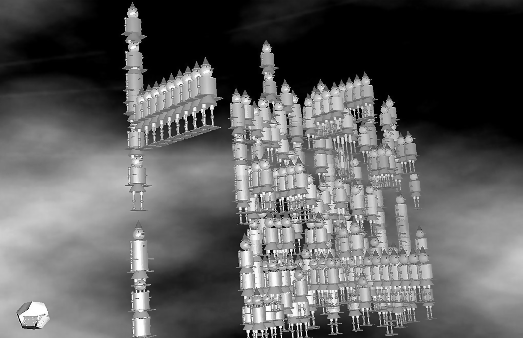
of pages is mapped to the color of the body, etc. When looking at the picture, one immediately sees prominent structures: The tower at the left are books with no author (some journals); the queue of Pinocchios attached to the tower are different volumes of one journal; from the color of the body one can see, that those journals’ volumes are quite thin compared to much thicker books on the right side. This kind of search uses the human brain’s most powerful part: The visual cortex, and is therefore superior to any text-based search. By variation of the mapping methods, one can now inspect all kinds of book properties.
9.2 Cockpits
Using this visualization, values of multimedia objects can be changed by graphical interaction. One can move the objects around or move, say, the arm of a Pinocchio to change the underlying data.
Extending this, we introduced the notion of cockpits where there is no data behind such a multimedia object but a Rubette. Manipulating such a cockpit object does not change any data, it feeds this information back to the Rubette in question. With this extension one can give every Rubette a GUI that represents the Rubette in the browser’s 3D-space and maps commands or I/O-ports on the multimedia objects. As these cockpits are structurally identical with the satellites,