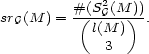
Here,  denotes the binomial coefficient.
The symmetry rate measures the amount of symmetry displayed by a melody in a very specific way. First, an actual symmetry within  certainly should involve at least three tones. Moreover, each symmetry patch of
  containing more than three tones contributes to the SR through its subsets, which are symmetry patches themselves. Hence, the longer a symmetry patch is, the more it adds to the numerator. Counting symmetry 2-patches in a melody seems particularly appropriate, since longer ones might not always exist. The denominator is introduced as a normalization with respect to the length of the melody. However, growing insights into the nature of melodic symmetry might and perhaps should result in a more appropriate normalization.
Of course, there are also higher symmetry rates for a melody  ,
,  , defined by
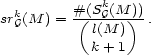
Note that  . By the Proposition from Section 2, the SR will generically vanish. On the other hand, computations for the samples listed in the Introduction resulted in the following. For the purpose of comparison, mean values were calculated for each of the corpora and either group.
Example 2 The table below lists the mean values of the symmetry rates for each of the three corpora described in the Introduction and both paradigmatic groups.
| Corpus | |  | |  |
|
|
|
|
|
| Bach Chorale Lines | | 0.055 | | 0.306 |
| Baroni/Jacoboni Phrases | | 0.045 | | 0.284 |
| German Children Songs | | 0.254 | | 0.489 |
Already these few figures seem to hint at qualitative differences with respect to symmetry between the three sets of related melodies. Considerably larger SRs for the children songs compared to both sets of chorale phrases certainly were to be expected, whereas the actual value of this difference for the counterpoint group and, even more, the remarkable contrast in the case of translational symmetries are somewhat surprising. Whether any conclusion could be drawn from the differences of the mean SRs for the chorale lines remains open for the moment. The fact that a