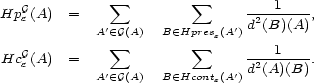
in addition, weight the individual contribution by a factor inversely proportional to the square of the one-sided distance. Through this modification, the sets containing extra tones lying further away contribute less than those with additional tones close to the given set.
5 Combinatorial Characteristics
There is a single elementary observation lying at the basis of this section.
Lemma 2 Let  be a melody and
  a paradigmatic group. Then each subset of a symmetry patch (with at least two elements) is itself a symmetry patch.
The restriction concerning the number of elements is only due to the definition of a symmetry patch in which, for natural reasons, we required  . The property stated in the lemma for the set
  of all symmetry patches of a melody with respect to some paradigmatic group is the decisive requirement defining a simplicial complex. This simple fact opens the topic of symmetry in melodies to the methods of combinatorial topology. Much of what has been said so far could be interpreted from this point of view. Instead, this section will deal with one of the central structures constructed for a simplicial complex: its homology groups. Since the definition and properties will not be needed here, we refer the reader to Spanier (1966), Chapters 3 and 4, for a concise introduction into the field as well as all relevant facts and methods. For the purposes of this note it suffices to state that the corresponding algebraic procedure associates with each finite simplicial complex
  finitely many abelian groups
  ,
,  , which are finitely generated. In particular, the ranks of these groups, rk
 , will be of interest in the sequel.