of translations only, which is shifted to second homology for the counterpoint group. To support this, we mention that the mean values of the largest dimensions with non-vanishing homology are 2.0 for  (3.0 for (3.0 for  ) in the case of the children songs and 1.1 for ) in the case of the children songs and 1.1 for  (2.0 for (2.0 for  ) in the case of the Bach as well as the Baroni-Jacoboni phrases. As the final point to be discussed in connection with these computations for the chosen sets of examples, let us look at some elementary statistical data. Already at first thought, one might expect a relation between the tone number of a melody and its (e.g., combinatorial) complexity. At least for a corpus with a distinct amount of homogeneity, the complexity should grow to a certain extent with increasing length of the melody. Here are the corresponding figures describing the relation between the tone number and the sum of the ranks of all homology groups in each case, for both groups. ) in the case of the Bach as well as the Baroni-Jacoboni phrases. As the final point to be discussed in connection with these computations for the chosen sets of examples, let us look at some elementary statistical data. Already at first thought, one might expect a relation between the tone number of a melody and its (e.g., combinatorial) complexity. At least for a corpus with a distinct amount of homogeneity, the complexity should grow to a certain extent with increasing length of the melody. Here are the corresponding figures describing the relation between the tone number and the sum of the ranks of all homology groups in each case, for both groups. 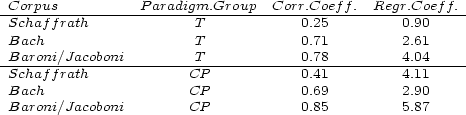 As these figures show, there appears to be some correlation between tone number and the sum of the ranks in the case of the Bach phrases, a slightly stronger one for the automatically generated phrases, and only weak correlation for the children songs. Moreover, the linear regression shows a different statistical behavior with respect to the dependence of the sum of the ranks on the tone number passing from As these figures show, there appears to be some correlation between tone number and the sum of the ranks in the case of the Bach phrases, a slightly stronger one for the automatically generated phrases, and only weak correlation for the children songs. Moreover, the linear regression shows a different statistical behavior with respect to the dependence of the sum of the ranks on the tone number passing from  to to  as well as for each group separately. as well as for each group separately. Since this note is not intended to present a comparative study of these three sets of melodies, but, instead, to describe a circle of methods and tools to be applied for this task, we only want to point out some phenomena already to be seen from the above evidence. First, there appears to be an (at least for the author) unexpected large amount of homology in all the examples. Second, the obvious difference between the sum of the homology ranks for the group  and the corresponding value for the group and the corresponding value for the group  is not as such a surprise. Remarkable, however, is the completely different behavior in the case of the children songs compared to the two other samples. For the former, the sum of the homolgy ranks more than doubles passing from is not as such a surprise. Remarkable, however, is the completely different behavior in the case of the children songs compared to the two other samples. For the former, the sum of the homolgy ranks more than doubles passing from  to to  , whereas these values slightly decrease in the cases of the Bach as well as the Baroni-Jacoboni phrases. (All this refers to the mean values.) As can be seen in the complete list of homology ranks, what happens in the latter case is a kind of shift in homology, i.e., enlarging the group , whereas these values slightly decrease in the cases of the Bach as well as the Baroni-Jacoboni phrases. (All this refers to the mean values.) As can be seen in the complete list of homology ranks, what happens in the latter case is a kind of shift in homology, i.e., enlarging the group  to to  by reflections in horizontal and vertical lines results in a kind of rank shift by one dimension up in homology. by reflections in horizontal and vertical lines results in a kind of rank shift by one dimension up in homology. There are three conclusions that could be drawn from this, admittedly rough, observation:
|