|
we can use the identification via  . Likewise we may refine these homogeneous profiles by attributing individual weights to the tone perspectives . Likewise we may refine these homogeneous profiles by attributing individual weights to the tone perspectives  and thus experimentally shaping and thus experimentally shaping  for each harmonic locus. for each harmonic locus. Remark 4 This second approach was implemented in the original HarmoRubette on the basis of Noll (1997) and is still avilable as the »Noll-Classic«-method. The Riemannian tonal functions are associated with profiles
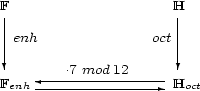
2.4 Concrete Tone SpacesWe close this section by defining some elementary tone spaces and derived structures in preparation of the subsequent sections. We start with chromatic pitch height    (i.e. (i.e.  ). Concretely we identify ). Concretely we identify  with with  , ,  with with  , ,  with with  , etc.). Furthermore we consider the enharmonic and the diatonic projections, sending note names to their enharmonic classes and to their diatonic classes: , etc.). Furthermore we consider the enharmonic and the diatonic projections, sending note names to their enharmonic classes and to their diatonic classes:   and and  of of  , as well as two interpretations , as well as two interpretations  and and  of of  form the following diagram: form the following diagram: Remark 5 The simultaneous consideration of all four tone spaces along these maps is a special instance of a well formed tone system (c.f. Carey and Clampitt, 1989). Formally, such a simultaneous view of a note name - pitch height concordance can be described as the limit of the above diagram (consisting of those pairs
|



 encoded according to MIDI, where 60 represents the >middle C<. Further one has