Given two local compositions  , a morphism
  is a couple
  , consisting of a morphism of presheaves
  and an address change
  such that there is a form morphism
  which makes the diagram of presheaves
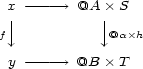
commute. This defines the
category  of local compositions
. If both,

are objective with

, one may also define morphisms on the sets

by the expressions

(forgetting about the names) which means that

is a set map such that there is a form morphism

which makes the diagram
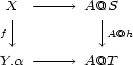
of sets commute. This defines the
category  of objective local compositions
. Every objective morphism

induces a functorial morphism

in an evident way. This defines a functor

This functor is fully faithful. Moreover, each functorial local composition

(again forgetting about names) gives rise to its
objective trace 
where

. If we fix the address

and restrict to the identity

as address change, we obtain subcategories

and a corresonding fully faithful embedding

. In this context, the objective trace canonically extends to a left inverse functor

of

. Moreover
For more algebraic calculations, such as Grothendieck topologies and  ech cohomology, one has to restrict to special subcategories. We shall therefore also look at the »address« category
  of left
  -modules with
  -affine morphisms for a given commutative ring
  . In this category, the set of morphisms from module
  to module
  is denoted by
  . We denote the corresponding category of (objective) local compositions by
  (
( ) Proposition 2 is also valid mutatis mutandis for
  .
.
3.2 Finite Completeness
So, on a fixed address, objective and associated functorial local compositions are quite the same. But there is a characteristic difference when allowing address change. This relates to universal constructions:


