|
and listings of isomorphism classes: In 1973 Allen Forte (Allen, 1973) established the list of 352 orbits of chords of pitch classes under the translation group  and the 224 orbits of chords under the group and the 224 orbits of chords under the group  of translations and inversions. In 1978, George Halsey and Edwin Hewitt (Halsey and Hewitt, 1978) succeeded to give a recursive formula for enumeration of translation orbits of chords in finite abelian groups, and enumerating the translation orbit number for chords in cyclic groups of cardinality of translations and inversions. In 1978, George Halsey and Edwin Hewitt (Halsey and Hewitt, 1978) succeeded to give a recursive formula for enumeration of translation orbits of chords in finite abelian groups, and enumerating the translation orbit number for chords in cyclic groups of cardinality  . In 1980, the author (Mazzola, 1981) calculated the list of 158 affine orbits of chords in . In 1980, the author (Mazzola, 1981) calculated the list of 158 affine orbits of chords in  , the list of 26 affine orbits of three-element motives in , the list of 26 affine orbits of three-element motives in  , and the list of 45 three-element motives in , and the list of 45 three-element motives in  . In 1989, Hans Straub and Egmont Köhler (Straub, 1989; Köhler, 1988) gave the list of all affine 216 four-element motive orbits in . In 1989, Hans Straub and Egmont Köhler (Straub, 1989; Köhler, 1988) gave the list of all affine 216 four-element motive orbits in  . In his works starting from 1991 to the present, Harald Fripertinger (loc.cit.) has given enumeration formulas for chord orbit numbers in . In his works starting from 1991 to the present, Harald Fripertinger (loc.cit.) has given enumeration formulas for chord orbit numbers in  under under  , and the full affine group, also for , and the full affine group, also for  -phonic -phonic  -series, all-interval series, motives in -series, all-interval series, motives in  , and Vuza canons in , and Vuza canons in  . He has calculated lists of affine motive orbits in . He has calculated lists of affine motive orbits in  for motives up to cardinality 6. for motives up to cardinality 6. The usage of classification has been annotated above, but there is one particular result which we cannot withhold from the reader: Fripertinger’s formulas yield the impressive number of   . This is of order . This is of order  against the estimated order of against the estimated order of  stars in a galaxy! So the musical universe is a serious competitor against the physical universe, in its quantity as well as in its quality of a spiritual antagonist. stars in a galaxy! So the musical universe is a serious competitor against the physical universe, in its quantity as well as in its quality of a spiritual antagonist. Let us briefly review the Pólya-de-Bruijn enumeration methods applied by Fripertinger. We typically work in the space 
Consider now »Pólya weights« 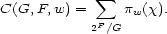
With these definitions, we have the following results:
|
 . A subset
  is identified with its characteristic function
  . For a permutation
  in a subgroup
  of the full group
  of affine automorphisms of
  , we have the
  , with
  number of cycles of cardinality
  . Take the indeterminates
  and set
  . Then the cycle index polynomial is defined by
 ![w(0),w(1) (- Q[x]](../graphic/Co930x.gif) and for a characteristic function
and for a characteristic function  , the product
  which is invariant under the canonical action of
  on
on  . Then, the
  , the
, the  -coefficient of
  is the number of
  -orbits of
  -element sets in
  .
.  , we have
  .
.