of

through the Identifier

; in this case, the coordinates are identified with a diaffine transformation of modules,

. It’s interesting and of practical importance to note that if we have the
»zero address
«,

, then

.
(b) In the case of Syn, the  correspond to an element of
  , that is, the functor of the Coordinator of the form of the denotator, evaluated at the address
  . From here on, we will use
  to designate
  , the form of the denotator.
(c) The coordinates  that correspond to
  Power are identified with a subfunctor of
  because of the isomorphism

We will examine this in more detail. In a topos of presheaves like  there exists a bijection between the set of sieves
  and the subfunctors
  and the subobject classifier in this topos is
  . The Yoneda functor,
  which is full and faithful, plus the existence of power objects in any topos, permits the following construction. Remember that
  and
and  . Furthermore, the power set
  in
in  induces a functor
  (for all
  defined as
  . In fact,
  is the composition of
  and the covariant »power set« functor
  .
.
We have:  . Then, if
  denotes the subfunctors of
  , there is an isomorphism

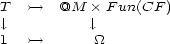
which can be illustrated by the following fiber product diagram for such a subfunctor

:
On the other hand, let  and
and  . Then
  and, of course,
  .
.
(d) For the TF Limit, the corresponding denotator consists in special lists in the product of all the  . Once again we will present this construction in detail: Suppose that the diagram of forms has vertices
  , (with
  a form) and functors
  that correspond to each
  . This means that
  is an arrow in the





