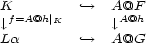
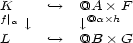
Therefore,

and

. Let

be objective, and

, with

. Then

and

. Conversely, if

then

is the functorial version of the local objective composition

.
It is very important to emphasize the difference between functorial and objective local compositions because, before the development of denotator theory, MMT used exclusively objective local compositions, which have certain restrictions that limit theoretical and practical applications.
Let  be a local composition,
  the functor of
  (the ambient space), and
  a diaffine morphism in
  . Fix
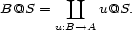
. Fix  . Then we have
6 Morphisms of Local Compositions
First we will define the morphisms for objective local compositions, and then for the functorial local compositions; once this is done, we will show the relationship that exists between them.
Now let us se how morphisms between functorial local compositions behave.