some events falls together with the beginning of others (at onset times

,

and

). The lower score has been annotated with fingering information (to be played with the left hand). Fingering is required if we want to construct a symbolic gesture curve with independent axes for each finger. Here, we assume that the fingering information was supplied by some external source, either manually, or by some automatic tool (e.g. a
FingerRubette in the context of RUBATO, or by methods described in
Parncutt (
1998)).
4.1 Fingers Moving at Infinite Speed
One of the main problems with symbolic gesture curves is the issue that fingers have to move at infinite speed in some cases: for instance at  the first event for finger 2 ends and at the same time finger 2 has to start playing the second event. The same is the case at
  , where finger 1 is still pressed and must be released, but there is no time for the release movement since the score is virtually finished. The problem can be solved by parameterising onset time for each symbolic finger, i.e. onset time
  becomes a function of the curve parameter
  .
.
Figure 3 shows the symbolic gesture curve for finger 1. As we just have seen, onset time  also exists in the gesture space, but separated for each finger. Each axis is drawn separately in function of curve parameter
  . The remaining instrument parameters
  ,
,  , etc. are replaced by pseudo space coordinates
  ,
,  ,
,  which define the coordinate system for a virtual keyboard.
  is the position on the keyboard and corresponds to pitch,
  is the position above the keyboard and tells whether key is pressed or not, and the derivative
  contains information about the speed at which the key is pressed or released, respectively. This speed corresponds to the loudness of a certain event. Note that the
  position (depth on the keyboard,
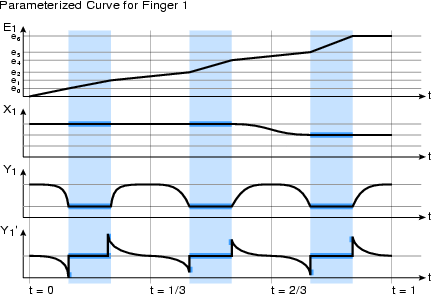
 running from 0 to 1 on the horizontal axis.