|
us also suppose that the command group of motions for the door is the rotation group  , since the door can rotate about its fixed hinge in the wall. Then, our claim is that the combined transform structure of the door and wall is given by a regular wreath product of the two command groups thus: , since the door can rotate about its fixed hinge in the wall. Then, our claim is that the combined transform structure of the door and wall is given by a regular wreath product of the two command groups thus:  The reason is easy to see as follows: Let us move the wall by a command operation
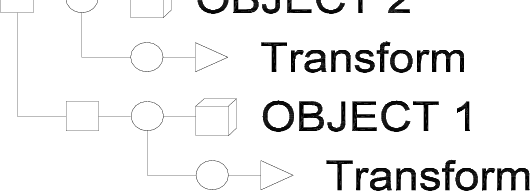
It will be useful, for later discussion in this paper, to consider here diagrammatic aspects of current design programs. Because run-time inheritance is created by the designer, it is usually represented by diagrams that the designer can view. It will be useful for us to show how these diagrams can be converted into algebra. A good diagrammatic representation is used by 3D Studio Max, as illustrated in figure 10. Here, inheritance is represented by indentation - i.e., an indented object is a child of the next object above with respect to which it is indented. Each object, except the World object, has a transform shown just below it. The transform relates the coordinate frame of the object to the coordinate frame of its parent. This transform is the ”personal” transform of the object. In addition, the object inherits the transform of its parent. The object therefore adds its personal transform to its inherited transform. This means, of course, that via its parent, it inherits the transform of its parent’s parent, and so on. By the above Algebraic Theory of Inheritance, such diagrams can be converted into algebra in the following way: Group of Entire Transform Structure. Consider a set of 
|
 . Then, because the door moves with the wall,
  moves a copy of the door’s rotation group
  together with the wall, i.e., sends the copy of the door’s rotation group within the first wall position onto the copy of the door’s rotation group within the second wall position. In fact,
  achieves this by
  , in the above wreath product, correspond to the copies of the doors’s rotation group in each of the different wall positions.