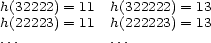
|
Proof: The uniqueness of the factorizations of conditions (i) and (ii) is trivial. To prove the existence of such a factorization, let  be the longest prefix of be the longest prefix of  such that such that  , where , where  is the corresponding suffix with is the corresponding suffix with  . We denote by . We denote by  the first symbol of the first symbol of  . The two possible values for . The two possible values for  are are  and and  . One has . One has  . Since . Since  is maximal, one has is maximal, one has  , but the rhythmic oddity property implies , but the rhythmic oddity property implies  , thus , thus  . . - If
 , ,  being even implies that being even implies that  is even, thus equal to zero, and is even, thus equal to zero, and  so that condition (i) is satisfied by the pair so that condition (i) is satisfied by the pair  and condition (ii) by the pair and condition (ii) by the pair  . . - If
 , ,  being even implies that being even implies that  is odd, thus equal to one. This gives two remaining cases. is odd, thus equal to one. This gives two remaining cases. - If
 , the equality , the equality  implies that implies that  so that condition (i) of the property is satisfied by the pair so that condition (i) of the property is satisfied by the pair  . . - If
 , the factorization , the factorization  is such that is such that  , so that condition (ii) of the property is satisfied by the pair , so that condition (ii) of the property is satisfied by the pair  . .![[]]() Proposition 1 implies that  (with (with  being even) so that being even) so that  and and  , thus expressing the »half minus one / half plus one« characterization of these patterns given in Arom (1991). , thus expressing the »half minus one / half plus one« characterization of these patterns given in Arom (1991). We introduce the notion of asymmetric pair that will be the key of our construction. Let  , ,  be words over be words over  . We say that . We say that  is an asymmetric pairs if no pair of prefixes is an asymmetric pairs if no pair of prefixes  of of  and and  respectively exist such that respectively exist such that  . For instance, . For instance,  is an asymmetric pair, but is an asymmetric pair, but  is not. is not. Proof: Let  or or  with with  . The existence of a pair of prefixes . The existence of a pair of prefixes  of of  and and  such that such that  and and  with with  is equivalent to the existence of a cyclic shift is equivalent to the existence of a cyclic shift  of of  (whatever being the (whatever being the
|