factorization

or

) such that

. Indeed, one has

, which gives the following computation
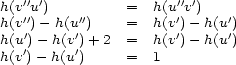
Thus if  satisfies the rhythmic oddity property, proposition 1 gives
  or
or  with
with  . Then
  must be an asymmetric pair. Conversely, if
  or
or  where
where  and
and  being an asymmetric pair, then no cyclic shift of
  can be factorized into words with equal height.
 ![[]]()
3 Construction of asymmetric pairs
The following construction is inspired by Rauzy’s rules, which are used to define standard pairs in the construction of characteristic Sturmian words J. Berstel (2001). Consider two functions  and
and  from
from  into itself defined by
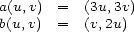
One has the following proposition.
Proof: Let  denote the smallest set of pairs of words containing
  and
and  closed under
  and
and  , and
, and  the set of asymmetric pairs. We prove
  by double inclusion. The first inclusion is obvious, since
  contains
  and
and  and is closed under
  and
and  . The other inclusion is proved by induction on the integer
  , where
  is an asymmetric pair and
  . The first case is
  . Then for each pair of prefixes
  of
of  and
and  , one has
  and
and  is a pair of prefixes of
  . If
. If  , then
  . This proves that if
  is an asymmetric pair, then so is
  . By induction,
  belongs to
  , which proves that
  belongs to
  .
.
The other case is  . Notice that
  cannot be the first symbol of
  , since
  is an asymmetric pair, which implies that
  cannot be a pair of prefixes of
  and
and  . Thus
  . Then for each pair of prefixes
  of
of  and
and  , one has
  and
and  where
where  is a pair of prefixes of
  . If
. If  , then
  . This proves that if
  is an asymmetric pair, then so is
  . By induction,
  belongs to
  , which proves that
  belongs to
  .
. ![[]]()
Considering the free monoid  on the alphabet
  , we identify the concatenation with the composition of functions. Thus any word of
  is identified with a function from
  into itself. It is easy to prove by induction the following properties.


