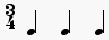
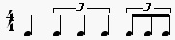
Until now, we have presented RTs where S was a list of integer elements, representing notes or beats. More complex elements may appear, as in the case of the following RT = (4/4 (1 (2 (1 1 1)) (1 (1 1 1)))).
The symbolic representation is essentially based on the hierarchical musical content. This allows an overall readability of the hierarchical structure and a symbolic format, which can be controlled by algorithms and other transformations such as inversion, recursion, etc. This is made possible by the fact that the description is an abstraction of the object itself. Musical editors can export data to other programs by using different formats like, midi, enigma or XML.
3 Mixing visual programming and music notation
In Section 2 we have described scores and patches as visual representations of musical material and compositional process. This section deals with interactions between these graphical entities.
3.1 Scores integrating visual programs
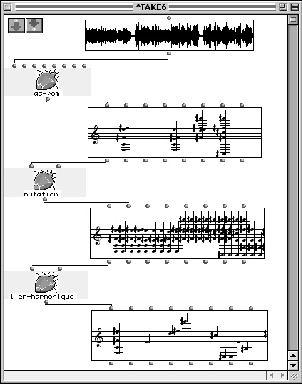
In OpenMusic we can integrate scores in graphic algorithms as components allowing the visualization of a particular data at a given moment of the computation. For doing that, we introduce particular boxes called factories. A factory is associated with a class and allows to create instances of this class. A factory contains a number of inlets corresponding to the public slots of the class. In a factory there are as many outlets as inlets. When evaluating an outlet, a new instance is created. The values provided by outlets are, from left to right: the instance itself, and the current values of its public slots. The new instance can be visualized graphically as a score. Figure 6 shows a visual program building a melody from an initial sound file.
The box as-¿om extracts principal partials of the sound and transforms them into a sequence of chords. The box mutation recovers the chord sequence and creates a new sequence by interpolating chords of the original one. Finally the box lien-harmonique transforms repetitions of equal notes into a new note having as duration the sum of the duration of the repeated notes.
In this approach the main composition space is the patch. Factories allow to trace data during the calculation time in a visual way. However patches fail in the arrangement of musical material in musical time. The experience with composers proves that putting scores in patches is particularly appropriate for building parts of a piece or simple material that will be used in a more structured way.