3.2 Visual programs integrating Scores
Editors have been extended so that programs may be inserted. This implies another way to consider the composition process: musical structures are subjected to modifications which are provided by visual programs. The composer has to choose which parts of the structure will be affected and simply connect them by means of visual algorithms. We explain this second approach with an example.
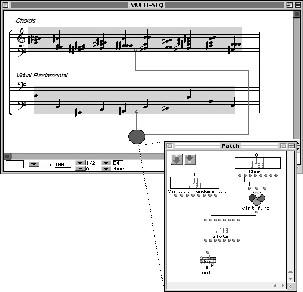
In Figure 7 we start from a sequence of random chords (Chords voice) and an empty sequence (Virtual fundamental voice). These two sequences are linked to a visual program, represented by a circle. If we open the editor of the circle, we have a patch editor, which fills the Virtual fundamental voice with notes corresponding to the virtual fundamental of each chord in the Chords voice. By evaluating the circle, the Virtual fundamental voice will be affected with the new result of the patch.
This approach allows a better local relation between parts of a composition. The score is a natural workspace for the composer, moreover it seems to be a good space for time organization. However including programs into scores produces some problems of visualization and navigation.
The two approaches we have shown in this section propose different styles of combination of calculus and edition for writing music. We present in the next