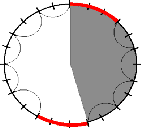
One can show several mathematical results on these formulas, that won’t be detailed here (see Chemillier and Truchet, 2003) for details. Anyway the possible and interesting formulas are obtained with an odd number of  -groups,
  , and even number of
  -groups,
  . For less than
  units on the circle (ie
  ), nearly all the possible formulas are actually played by the african peoples.
The CSP modelization is straightforward, take a Permut-CSP with variables  , permutations of the set made of
  times
times  and
and  times
times  , and as constraints (forgetting the modulos in the notation for legibility reasons)

The goal in to count the number of solutions depending on  and
and  . For small values, it is quite low, but increases very fast with
  and
and  .
.
2.2.3 Ligeti’s texture
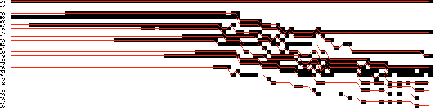
This problem, an analysis of Ligeti’s textures, is related to many Ligeti’s works which are called pattern-meccanico (Clendinning, 1993). It has been proposed by Marc Chemillier (Chemillier, 1999). These constraints describe a texture underlying the score, sort of a squeletton of the harmony. On the score, aggregates  are played as short motives quickly repeated in a mechanical fashion, such as in the piece Continuum for harpsichord. We will concentrate here on a texture taken from the beginning of the orchestral piece Melodien, see figure 7. In this piece,
  has value
  . The MIDI codes of the notes range from
  to
to  .
.
Given a sequence of  aggregates
  with less than
  notes each, try to find a
  voice polyphony denotated as an array
  so that :
- the
 extend the chords
  is included, i.e.
- voices which are not playing any note from the corresponding aggregate must stay on the same pitch
 , i.e. if
  , then
  ,
, - melodic motions in each voice are limited to the following intervals :
 ,
,  ,
,  or
or  semi-tones, i.e.