|
A first approach concerns existing software. Here a Rubette will be designed that is propped on the application. The functionality will be accessible via Rubette commands, a user interface to these commands will be exported as a cockpit and the data itself will be represented as satellites. Software that is modular will be quite simple to convert to the new paradigm. The conversion is especially straightforward when the data exchange is effected with XML. As the denotator data model is more general than the XML model, transporting XML data in the form of denotators is almost immediate. New software intended to work within the RUBATO system will, of course, provide a Rubette interface from the beginning. The actual backend doesn’t have to be implemented in Java, the only requirement is that somewhere data is exported as denotators.
8 SpatializationFor multimedia navigation of music data, the Distributed RUBATO platform relies on the PrimaVista Browser, a Rubette that was designed to transform abstract denotator databases into 3D multimedia objects, to manipulate them, and to transform them back into abstract denotators. By the universality of the denotator format, such denotators may be single sounds, voices, entire scores, or collections of such scores, etc. The core transformation algorithm is a one-to-one ”folding” map which preserves the linear orders among denotators. Folding has to cope with arbitrary recursive depth of denotator structures, including circularity in the definition of denotators and/or of their ambient spaces. Independently of the denotator complexity, the output of the folding algorithm is an array of vectors in
8.1 Folding |
 -space,
  being chosen by the user.
  -Space
 on a finite set
  . The map
  is order-preserving for the lexicographic linear ordering on
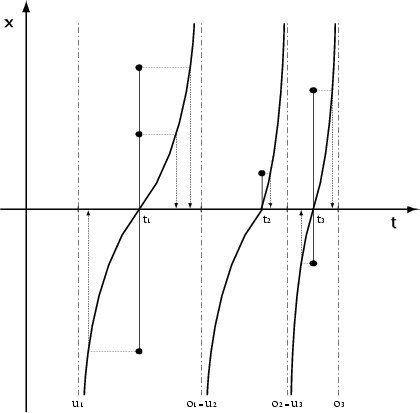
  -space. Its definition is recursive on the dimension n and starts with the 2-dimensional case. One writes
  as disjoint union of the subsets
  of those points having a determined first coordinate
  . One then draws disjoint vertical strips around each
  and maps the points of
  into the horizontal interval of the ith strip by use of a arcustangens function, see figure
  -dimensional case uses the projections
  ,
,  of a point
  in
in  to its first coordinate
  and to the remaining coordinates 2 to
  . We then have
  , but observe that
  depends on the set
  where it is defined! Clearly, this definition recursively inherits ordering-preservation which is evident for
  .
.