|
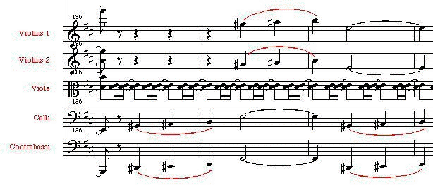
would begin on the first beat of the measures (»Die melodischen Motive, die ihren Ursprung in den ersten Takten des Satzes haben, passen in das  -Metrum. Sie klingen, als wären ihre Anfangstöne jeweils auf der >Eins< des Taktes. So sind sie aber nicht notiert.«18 ). Moreover the syncopations of the horns (see viola in figure 21) disturb the emergence of any downbeats (» ... nivellieren die scheinbar nie endenden Hörnersynkopen jegliches Gefühl für einen Schwerpunkt.«19 ). The same passage (Frisch, 1990) discusses as a »massive canonic and metrically disorienting episode«20 . -Metrum. Sie klingen, als wären ihre Anfangstöne jeweils auf der >Eins< des Taktes. So sind sie aber nicht notiert.«18 ). Moreover the syncopations of the horns (see viola in figure 21) disturb the emergence of any downbeats (» ... nivellieren die scheinbar nie endenden Hörnersynkopen jegliches Gefühl für einen Schwerpunkt.«19 ). The same passage (Frisch, 1990) discusses as a »massive canonic and metrically disorienting episode«20 .
The metric weight of a greater segment including this passage (measures 127-155) in figure 22 allows no correspondence to any possible time signature whatsoever due to the great metric weights on the first, third, fourth and sixth eighths of the measures. Hence it confirms Epstein’s observation of metric uncertainty. The analysis of the bassoon, violins, cello and bass already discussed in the beginning (see figure 3), which form the melodic voice, confirms Epstein’s observation regarding the second beats of the measures. The greatest metric weights are located on the second beats of the measures, the periodicity of the weight respects the layers of strong and weak beats of The metric weight of the instrumental parts characterized by the syncopations (see figure 23) shows a periodicity which does not correspond to any time signature whatsoever. Great metric weights are located on the third and fourth sixteenths as well as on the seventh and eighth sixteenths and the eleventh and twelfth sixteenths. It confirms Epstein’s observation that these syncopations are responsible for a lack of a clear metricity within this passage.
Inner metric analysis of the entire exposition of the first movement brought to light three different parts of regularities. Furthermore we detected new characteristics of inner metric structure within these parts by choosing smaller contexts, such as segments or voicing. These characteristics were not inherent in the analysis |
 . Hence metric coherence can be found, a phase shift takes place.
