- 313 -Mazzola, Guerino / Noll, Thomas / Lluis-Puebla, Emilio: Perspectives in Mathematical and Computational Music Theory 
  Erste Seite (1) Vorherige Seite (312)Nächste Seite (314) Letzte Seite (454)      Suchen  Nur aktuelle Seite durchsuchen Gesamtes Dokument durchsuchen     Aktuelle Seite drucken Hilfe 

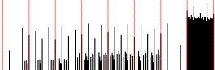
of the weights regarding these three segments furthermore demonstrates, that we obtained a common characteristic of the thematic material associated with the time signature of 4 4 .


PIC
Figure 25: Metric weight of measures 62-91 of the 2. movement (4 4 )


PIC
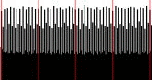
Figure 26: Metric weight of measures 96-103 (time signature 44 )


PIC
Figure 27: The beginning of the theme in the cello


The analysis of the first segment notated as 12 -8 reveals in figure 29 five sections of different density within the flow of successive note events: quarter notes and eighth notes alternately shape the rhythmic flow in the first section (lowest metric weights), whereas the interplay of violins and violas in the second section results in a continuous sequence of eighth notes (measures 45-48). This sections follows a continuous sequence of sixteenth notes (measures 49-52). The flow of events gets even more dense in the next segment (measures 53-57) since a continuous motion of thirty-second notes (segment of the greatest metric weights in figure 29) appears. In measure 58 the first theme from the very beginning starts its repetition.


PIC
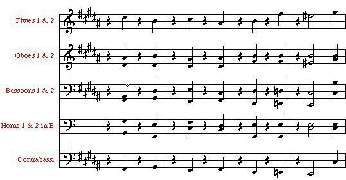
Figure 28: Measures 6-9 in the accompanying parts


PIC
Figure 29: Metric weight of measures 33-61 (time signature 128 )


Within each segment of the metric weight up to the beginning of the first theme in measure 58, the highest layer is not differentiated, as the detailed figure 30 illustrates. Layers can be distinguished, but the metric weights of the twelve beats of the measure are not differentiated at all within the highest layer. This lack of differentiation corresponds to a characterization in Epstein (1994) of this movement as being an example of a continuous motion with a minimum of structural accents (»... eines der atemberaubendsten Beispiele der Technik der ununterbrochenen, geführten Bewegung und des Mindestmaßes an strukturellen Schwerpunkten.«21

 
21  
Epstein (1994, p. 13)
)


PIC
Figure 30: Detail of figure 29 for measures 53 ff.


On the contrary, the repetition of the first theme at measure 58 results in a metric weight of the corresponding part, that assigns the greatest metric weights to the first, fourth, seventh and tenth beats within the highest layer (see figure 31). This differentiation enlightens the relationship between the two alternating time


Erste Seite (1) Vorherige Seite (312)Nächste Seite (314) Letzte Seite (454)      Suchen  Nur aktuelle Seite durchsuchen Gesamtes Dokument durchsuchen     Aktuelle Seite drucken Hilfe 
- 313 -Mazzola, Guerino / Noll, Thomas / Lluis-Puebla, Emilio: Perspectives in Mathematical and Computational Music Theory