|
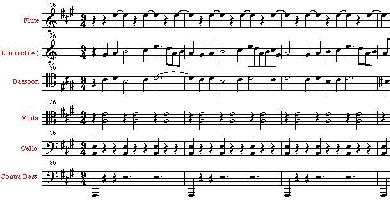
seventh beats. The leading voice in the clarinet is rhythmically very distinct. The theme begins on the second quarter note of measure 36, its entrance motive is repeated in measure 37 in a slightly varied form. But in measure 38 the motive starts on the third beat and is hence shifted. This technique of shifting corresponding motives regarding their position in the measure Frisch called metric displacement. Hence we want to discuss the analysis of the theme (see clarinet in measures 36-39, the violas in measures 40-43, the oboe and clarinet in measures 44-46 and the violins in measures 47-48).
The metric weight of the theme in figure 65 shows a very distinct regularity compared with the weight of all instrumental parts of this section. Within the first measure the greatest metric weights are located on the third and seventh beats, in the second measure on the fourth and sixth beats and in the third measure on the first and ninth beats. Obviously this does not correspond to the outer metric hierarchy.
The interpretation of the same weight as  in figure 66 at least results in a regularity which fits to the bar lines. The greatest metric weights are situated on the first and third beats of the measures. If great metric weights would be located on the fifth beats as well we could state metric coherence to a in figure 66 at least results in a regularity which fits to the bar lines. The greatest metric weights are situated on the first and third beats of the measures. If great metric weights would be located on the fifth beats as well we could state metric coherence to a  -meter. But in many cases the fifth beats get low metric weights. Hence metric coherence cannot be stated. Interestingly, Brahms notated the theme within the development (measures 77 ff.) in a slightly varied version as -meter. But in many cases the fifth beats get low metric weights. Hence metric coherence cannot be stated. Interestingly, Brahms notated the theme within the development (measures 77 ff.) in a slightly varied version as  . Hence the result of the isolated analysis of the theme might enlighten a hidden structure of the theme Brahms . Hence the result of the isolated analysis of the theme might enlighten a hidden structure of the theme Brahms
|