|
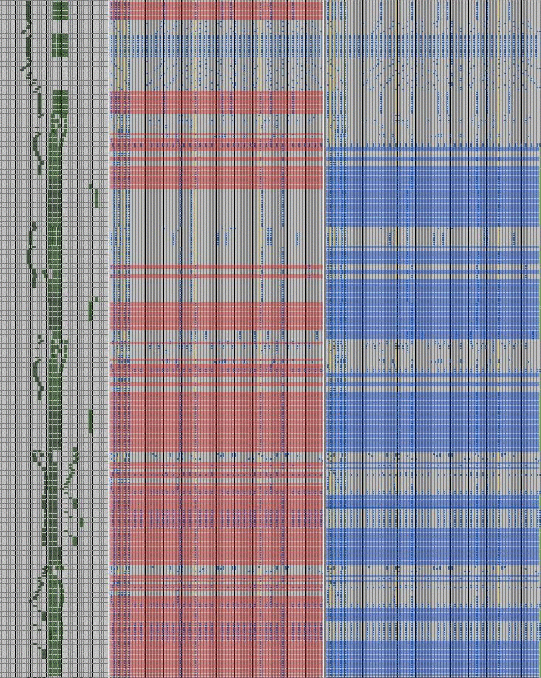
Figure 4 simultaneously displays the presence of two morphemes   (c.f. subsection 4.2). Considering them as intensions of new morphemes would yield extensions solely consisting of super-chords of the d-minor triad. Therefore we try to get rid of at least one constant tone in both monoids. There is only possibility to do so (otherwise we do not get monoids): (c.f. subsection 4.2). Considering them as intensions of new morphemes would yield extensions solely consisting of super-chords of the d-minor triad. Therefore we try to get rid of at least one constant tone in both monoids. There is only possibility to do so (otherwise we do not get monoids):  |
 (middle) and
  (right).
 and
and  in the d-Minor passage (bars 173 - 203) from the first movement of Schubert’s
  -Major Sonata (D 960). This passage is immediately followed by the >official< recaptitulation and--at the same time--has some characteristics of an already >pretended< recapitulation (cf.
  ) of the dominant and the leading-tone-triad (
 ) of the tonic supports this ambiguity. The Monoid
  with
with  is the intension of the bigeneric morpheme
  . With respect to semitone-encoding this is associated with the d-minor triad. The corresponding left ideals