|
and hence obtain the following simplified >classic< Riemann Logic:  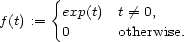  and may also experiment with the identity, the normal exponential function or a custom function. and may also experiment with the identity, the normal exponential function or a custom function. In Mazzola’s original implementation the formula for  The present version of the HarmoRubette offers two ways of taking the (n-elemented) set
|
 was
was  but only to (realisations of) third chains. A
  with
with  such that the corresponding sequence of partial sums
  contains no dublicates. The realisation of a third chain
  at pitch class
  is the tone set
  . For any tone set
  we consider the collection
  of all minimal third chain realisations containing X, namely
  into account (the second of which is the original proposal), namely
  and to calculate
  (c = normalizing factor),
  to all characteristic profiles for minimal third chains