3.3 Aspects of the Re-Design
A major drawback of the original implementation was the unclear distribution of scientific responsibility between the creators of the tool and the user. On the one hand there was a high amount of pre-defined settings (such as the overall approach, the elements of space  , parametrized formulas, etc.). But on the other hand there was a high amount of user-defined parameters, which--from the user perspective--actually accessed a >black box<. Therefore, the guiding idea of our re-design of the program was to keep the overall idea of harmonic pathway analyses in the restricted sense to first-order-transition models, but--within this framework--to delegate the full scientific responsibility to the user, by giving full access to all parts of the analysis. Much effort has been invested by the second author to allow various ways of customization of the program at runtime. These new possibilities exemplify a general concept of software-integration in computer-aided experiments in music theory and analysis (see Garbers (2004) in this volume, as well as Garbers (2003)). With help of the scripting language
  the user may change the theory settings for a harmonic pathway analysis and may experiment with a harmonic space, Riemann Logics and best path calculation of his/her choice.
| | After satisfactory experiments an expert can of course join the OpenSource project and implement the specific approach in ObjectiveC and thereby accelerate the calculations. |
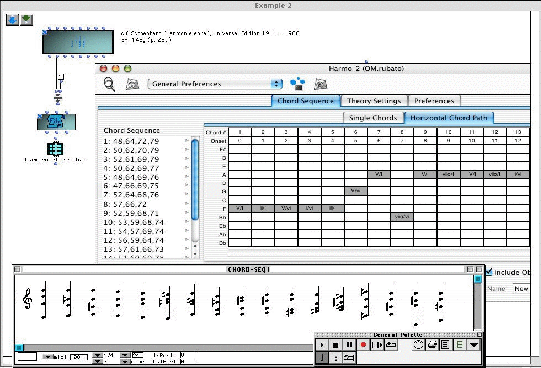
Another integration aspect is the possibility of remote control of the program for batch processing and other purposes. An
OpenMusic-user
| | see for example Agon (2003) in this volume. |
can integrate >wrapper-patches< into his/her own
OpenMusic programs and send chord-sequences as well as theory settings to
RUBATO and receive the results as Lisp-expressions. At the same time it is possible to inspect the results of these calculations (being stored in
RUBATO) within the graphical user interface of the
HarmoRubette. The second author also developed an
OpenMusic library supporting the visual programming of
FScripts.
A further practical drawback of the original tool was the high calculation time due to a purely combinatoric implementation for the best-path-selection. The Viterbi-algorithm offers a significant improvement. Furthermore the user may interactively force pathways to pass trough custom local selections (weighted filters) of harmonic loci (c.f. Subsection 1.5).
Finally, there are recent publications offering proposals for harmonic configurations spaces and as well as for harmonic path analyses. These research activities added further motivation for this software project. In the subsequent sections 4 and 5 we recapitulate and reformulate the approaches of Chew (2000) and Lehrdahl (2001) by embedding them into the present framework.
4 Elaine Chew’s Spiral Array
Elaine Chew (c.f. Chew, 2000) studies a hybrid space, which comprizes three levels of description, namely tones, triads and keys and distinguishes five families of music-theoretical objects each of which is parametrized by the abstract family of note names  .
.