
However, what Lerdahl actually proposes is not this strict hierarchy, but a weakened version of it, where each locus is directly connected with six regional centers instead of just its own one. These regions are called
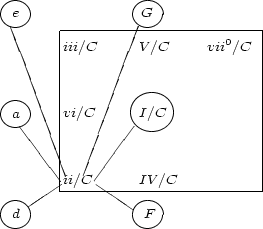
pivot regions. Figure
8 displays the
chart of the six pivot regions for the loci in the

-major region Maj(
C). The same six regions serve also as pivot regions for loci of the a-Minor region Min(
a). The proposal resembles the quasi-hierarchical organisiation of public transport. Local trains (or busses) move between peripherical loci and several regional centers while inter-regional trains connect regional centers but do not stop at peripherical loci.
The pivot region chart of an arbitrary major region  is the set

The same pivot region chart is associated with the minor region

relative to

, i.e. we have

The local pivot distances

are specified in table 5.3.
| Table 3: | Local pivot distances of chordal loci in the C-major and the a-minor region to their common pivot regions |
|
This map is extended to a map  which is calculated as follows. For loci in the same region
 coinsides with the intra-regional distance
  . For loci in different regions
  is the minimum length of the
  indirect possible pathways between these loci via their pivot regions, i.e.

where

vary through the pivot regions of

and

respectively. Lerdahl calls
 chordal/regional distance
 without discussing the
 to its pivot region centers


