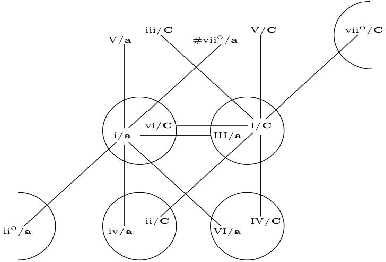
if  and and  for all loci for all loci  , different from , different from  and and  . Finally, they are called indistinguishable, if they are both, extensionally and intensionally indistinguishable. . Finally, they are called indistinguishable, if they are both, extensionally and intensionally indistinguishable. The following proposition provides a construction for a reduction of a given space  with respect to the intensional indistinguishabilities of a transition value map with respect to the intensional indistinguishabilities of a transition value map  . . Proof: Reflexivity and Symmetry are evident. As to the transitivity, let  be intensionally indistinguishable from be intensionally indistinguishable from  and let and let  be intensionally indistinguishable from be intensionally indistinguishable from  . If . If  is any locus different from is any locus different from  we have we have  as well as as well as  . In the case of . In the case of  we have we have  . The last statement follows from the definition of intensional indistinguishability. . The last statement follows from the definition of intensional indistinguishability. ![[]]() Now we consider our particular cases  and and  . If two loci are intensionally indistinguishable with respect to all the partial intra-regional, pivotal and inter-regional distances then this property is inherited by both . If two loci are intensionally indistinguishable with respect to all the partial intra-regional, pivotal and inter-regional distances then this property is inherited by both  and and  according to their construction. As we will see in subsection 5.6 all these partial distances are calculated on the basis of diatonic stratifications of triads. As certain loci in modally relative regions have the same stratifications and they are intensionally indistinguishable. In the case of C-major and a-minor regions we have: according to their construction. As we will see in subsection 5.6 all these partial distances are calculated on the basis of diatonic stratifications of triads. As certain loci in modally relative regions have the same stratifications and they are intensionally indistinguishable. In the case of C-major and a-minor regions we have:  Each of the twelve pairs of modally relative regions consists of 9 equivalence classes (c.f. Figure 9). The resulting reduced chordal/regional space consists of 108 loci and is denoted by Each of the twelve pairs of modally relative regions consists of 9 equivalence classes (c.f. Figure 9). The resulting reduced chordal/regional space consists of 108 loci and is denoted by  . It can be equipped either with a para-distance . It can be equipped either with a para-distance  (inherited from (inherited from  ) or with a distance ) or with a distance  (inherited from (inherited from  ). ).
5.5 Lerdahl versus Lerdahl: The Faith-motive The following example shows that Lerdahl did not strongly apply his theoretical principles from the chapter 2 of his book to the examples discussed in chapter 3 of his book. For the discussion of the harmonic pathway analysis of the Faith motive from Wagner’s Parsifal (bars 45 - 55) we may assume that the space  consists just of the 36 major, minor and diminished triads. The analysis consists just of the 36 major, minor and diminished triads. The analysis
|