|
in Mazzola (1985). Those results also included recursive algorithms to calculate classes of global compositions in modules of finite length. They have been generalized to compositions of variable address (Mazzola, 2001b,a). In the following subsections, we want to give a series of concepts and results which describe the recent classification theorems on variable addresses. Assumption 1 In the following discussion of classification theory, we shall always assume that the global compositions are Let us start with the standard compositions of the theory. They represent compositions with »notes in general position«, i.e. their configuration is as »free« as possible from >occasional< coincidences. In fact, the standard composition is a geometric realization deduced from the nerve Given a module
for
This defines a local,
 , with associated local composition , with associated local composition  , then there is exactly one morphism of local compositions , then there is exactly one morphism of local compositions
This morphism is in fact defined by the universal property of the coproduct and is mediated by the following affine function 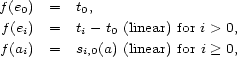 |


 of the composition, i.e., of its covering
  , and thus depends only on combinatorial information. There is a natural projection from the standard object onto the generating composition. Here is the formal construction:
  in
in  and a natural number
  , we denote
  the affine
  -fold coproduct
  of
of  . By construction, there is an isomorphism
  . We denote the canonical basis of
  by
by  , and for any element
  and
and  , we set
  for the
  -tuple in
  having
  at its
  -th position and zero else; the zero element is denoted by
  . We have the inclusion morphisms
 , with
 -addressed composition
  which is called the
 . By construction, it has the following property: If
  is any
  -module, and if
  is any sequence of
  -addressed points9

 : Write
  . Then we have