|
file or a real-time MIDI input, respectively, to an event space, for instance defined by  , ,  , ,  , and , and  (onset time, pitch, loudness, and duration). (onset time, pitch, loudness, and duration). More important however are possible applications of the ‘freezing’ operation: these provide mechanisms for recording gestures from given performances. The most simple, but also the most wide-spread use of such a mechanism is MIDI recording, resulting in a recorded score.
5 ResultsA framework for the realisation of gesture spaces and transformations between them has been implemented as a Performance-Rubette in the Framework of Distributed Rubato and thereby has been inspired by the synonymous Rubato component. The current state of implementation contains a model for symbolic gesture curves, which, as described, resembles the one of a virtual keyboard and thus is close to MIDI. Further, methods for construction and ‘freezing’ of symbolic gesture curves haven been implemented.
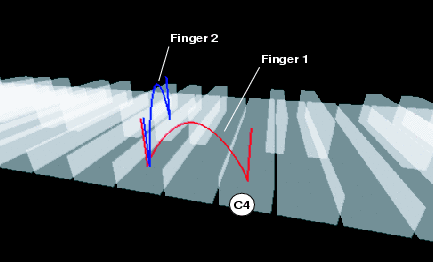
The software constructs symbolic gesture curves from given MIDI files (under the condition that appropriate fingering information is provided by the user, since it is not contained in a MIDI file) and the resulting output, interpolated numeric curve data, can be fed into an animation system. Figure 5 shows the constructed symbolic gesture curve for the simple score in the previous examples. The figure does not contain time information but rather shows the path the two fingers would follow over the whole duration of the score.
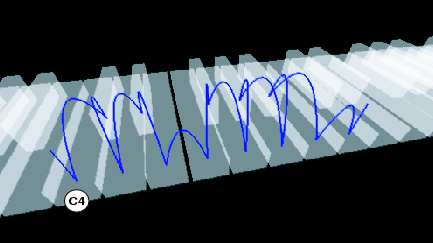
Figure 6 shows a second example, a chromatic score played with the left index finger, starting at C4. The two examples have been displayed with Soundium / Decklight, |