|
‘pressed’. At the borders of the event interval the values of  are set corresponding to the given velocity of the event. The outside borders of the transition intervals are either defined by an absolute value (if there is no neighbour interval, as it is at the beginning and at the end of the score) or by the transition to the neighbour interval. For example in figure 3 the transitions from the second to the third event (at are set corresponding to the given velocity of the event. The outside borders of the transition intervals are either defined by an absolute value (if there is no neighbour interval, as it is at the beginning and at the end of the score) or by the transition to the neighbour interval. For example in figure 3 the transitions from the second to the third event (at  ) are a change in pitch (the transitions in ) are a change in pitch (the transitions in  ) and ‘release key’ plus ‘press next key’ for ) and ‘release key’ plus ‘press next key’ for  . The transition curves are cubic interpolations of their border values and tangents. . The transition curves are cubic interpolations of their border values and tangents.
Figure 4 shows the symbolic gesture curve for finger 2 of our score (c.f. figure 2). Observe the two transitions below and after 4.3 Freezing a Symbolic Gesture CurveWhile we have just dealt with the construction of symbolic gesture curves, which was denoted by the ‘thawing’ operation in figure 1, let us add a concluding remark on the reverse process, the ‘freezing’ of symbolic gesture curves. Since the symbolic gesture spaces are similar to the “Note on”, “Note off”, and “Velocity” concepts offered by MIDI, the ‘freezing’ operation in the symbolic domain is easy compared to the construction of a gesture curve: it is basically the transformation of a MIDI |
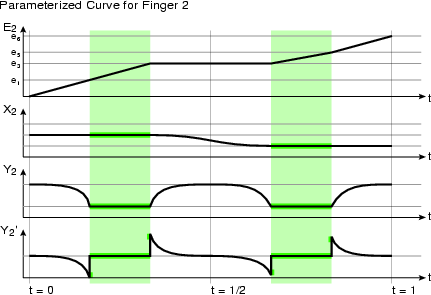
 running from 0 to 1 on the horizontal axis.
 , where onset time
  remains constant and the finger moves in zero time from one key to the next. Finally note that the curves in figure