|
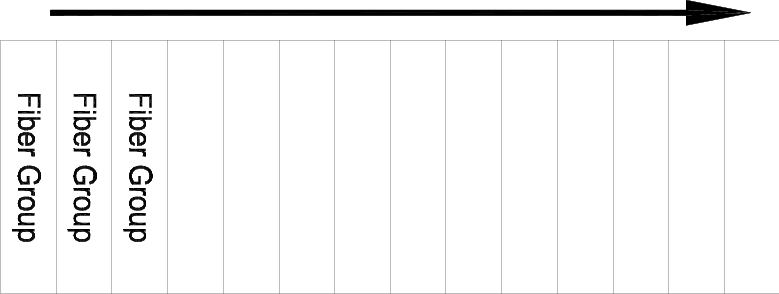
actions within the sequence. Indeed we argue that an artwork, e.g., a symphonic movement by Beethoven, is a structure that has maximal complexity while simultaneously maximizing transfer along the generative sequence. That is, the principle of the maximization of transfer can be stated thus: Maximization of Transfer. Make one part of the generative sequence a transfer of another part of the generative sequence, whenever possible. It will be argued that the appropriate formulation of this is as follows: A situation of transfer (see figure 1) involves two levels: a fiber group, which is the group of actions to be transferred; and a control group, which is the group of actions that will transfer the fiber group. The justification for these structures algebraically being groups will be given later, but the theory of transfer will work equally for semi-groups, which is the most general case one would need to consider for generativity. Now, one can think of transfer as the control group moving the fiber group around some space; i.e., transferring it. The transferred versions of the fiber group are shown as the vertical copies in figure 1, and will be called the fiber-group copies. The control group acts from above, and transfers the fiber-group copies onto each other, as indicated by the arrow. This will often be referred to as a structure of nested control.
Two basic requirements of our approach are this: Transfer will be modeled by a group-theoretic construct called a wreath product. This is a group that will be notated in the following way: 
|