Intuitively, a wreath-product is a group that contains the entire structure shown in figure
1; that is, it has an upper subgroup that will be called a
control group, and a system of lower subgroups that will be called the
fiber-group copies. The control group sends the fiber-group copies onto each other. It does so simply by conjugating them onto each other.
6 Wreath Products
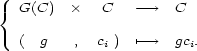
This section describes wreath products in detail. Consider a group,  , called the control group, acting on a set,
  , called the control set. This action, called the control action, is given thus:
 | (1) |
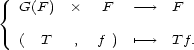
Consider also another group,  , called thefiber group, acting on a set,
  , called the fiber set. This action, called the fiber action, is given thus:
 | (2) |
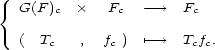
For each member  of the control set
  , make a copy of the fiber action (2), thus:
 | (3) |
Notice that there will now be a set of copies  of the fiber set, called the fiber-set copies, indexed in the control set
  . Also, there will be a set of copies
  of the fiber group, called the fiber-group copies, also indexed in the control set
  . The fiber-group copies correspond to the columns in figure 1. Each such column acts on its own ”personal” copy of the fiber set.
The following point is crucial: If we think of the control action, given at (1) above, as a permutational action by the control group on the elements of the control set, then this same action induces a permutational action by the control group on the copies of the fiber. The latter permutational action is indicated by the arrow in figure 1.
In most cases, in this paper, the control set  will be the control group
  itself. Thus the fiber copies will be indexed in the control group. This is called a regular wreath product. In figure 1, this would mean that there is one column (fiber-group copy) for each element in the control group above. However, the present section defines the most general type of wreath product - where the set
  is some general set on which the control group has an action.
Now take the direct product of the fiber-group copies. This will be called the fiber-group product, given thus:
 | (4) |