|
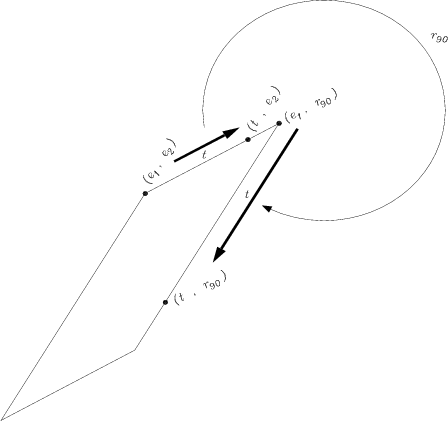
coordinates of another side. Notice that, given an individual point  on a side, its four transfer-equivalent copies (on each of the four sides), are now given by the diagonal embedding of the fiber group into the fiber-group product, thus: on a side, its four transfer-equivalent copies (on each of the four sides), are now given by the diagonal embedding of the fiber group into the fiber-group product, thus:  . .
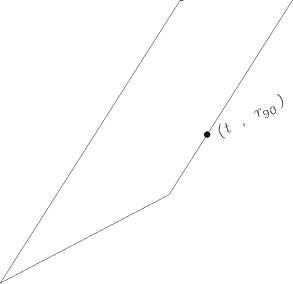
Now, deformed shapes are handled in our system by adding extra layers of transfer. For example, to obtain a parallelogram, one adds the general linear group
Notice that the operation used to add More deeply still, the fiber group
What has been illustrated here is our principle of the maximization of transfer: The parallelogram is given a generative description, all the way up from a point, that maximizes transfer. That is, the point is transferred by translations to create a side, the side is transferred by rotations to create a square, and the square is transferred by the general linear group to create a parallelogram. Everything is re-used. This is the basis of our theory of aesthetics. For example this is the basis of a symphonic movement by Beethoven. We are giving here a simple first illustration of the mathematical principles involved. |
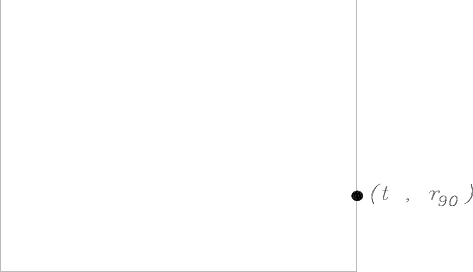
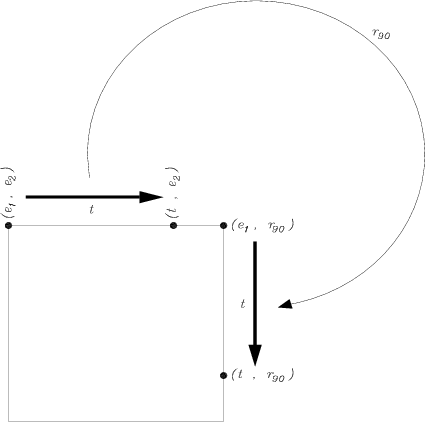
 onto the two-level group of the square thus:
 on to the lower structure
  is, once again, the wreath-product
  which means that
  acts by
  , as follows: Since the fiber group
  represents the structure of the square, this means that
  transfers the structure of the square onto the parallelogram. In particular, it transfers the
  transfers the four points on the square in figure
  in expression (
 , onto the parallelogram, as shown in figure
  operations in expression (