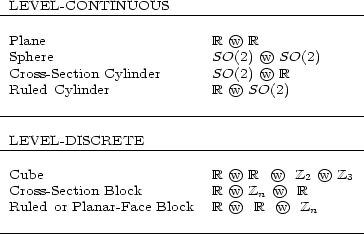
To illustrate the concept of an iso-regular group, notice carefully that two of the groups given earlier are examples of iso-regular groups, namely: Square Now turn to the Inferred Starting States Principle given above. We will soon see deep illustrations of this in music, but as an initial intuitive example in the visual domain, consider a bent pipe that you might see lying in the road. It is clear that, merely by describing this as bent, you understand the generative origin to have been a straight pipe, i.e., a cylinder. But a cylinder is given by an iso-regular group. So the generative origin is characterized by an iso-regular group, which is what is predicted by the Inferred Starting States Principle. One powerful advantage of this principle is that it allows us to give a systematic classification of the surface primitives (starting states) of visual perception and computer-aided design. This is shown in Table 1. Not only do iso-regular groups characterize the starting states in human perception and computer-aided design, but they characterize the starting states of physics (e.g., flat-space time universes in relativity, and sets of commuting observables in quantum mechanics), as shown by us in Leyton (2001). The next section will demonstrate their crucial importance to music. Our claim is that the fundamental power of structuring origin states by iso-regular groups is that this allows maximal recoverability. |
 -fold wreath product,


 .
.  is either a cyclic group or a connected 1-parameter Lie group.
  is represented as an isometry group.
 and Cylinder
  .
.