19 Musical Meter
With the above proposal, that origin states are iso-regular groups, it is now possible to understand deep aspects of musical structure. We will first examine musical meter. Standardly, one says that the beat stream is divided into a number of levels of groupings:
- Primary accent grouping.
- Secondary accent grouping.
- Division into beats.
- Division of beats.
- Subdivision of beats.
The first level corresponds to the bars. The second is the major division of the bar, that occurs in the case of bars with more than three beats. For example, 4/4 time is usually perceived as divided into two successive subgroupings of two beats. The third level is the division into the beat itself. And the fourth and fifth levels are successive divisions of the beat. Now for our algebraic theory of meter:
Algebraic Theory of Metrical Structure. Given a metrical unit (e.g., a bar, a subgrouping, a beat), its occurrence within the next higher unit is given by a cyclic group  , and its division is given by a cyclic group
  . The upper group
  transfers copies of the lower group
  as fiber, along the musical work. Therefore, the relation between the upper and lower group is that of a regular wreath product:

The full metrical hierarchy, corresponding to the accent hierarchy of the bar structure, is therefore given by an  -fold wreath product

If one defines the standard invariant metric on time, then this wreath product is an iso-regular group.
A particular aspect of this statement can be given as follows:
Theory of Division. Division by  is wreath sub-appendment by
  .
.
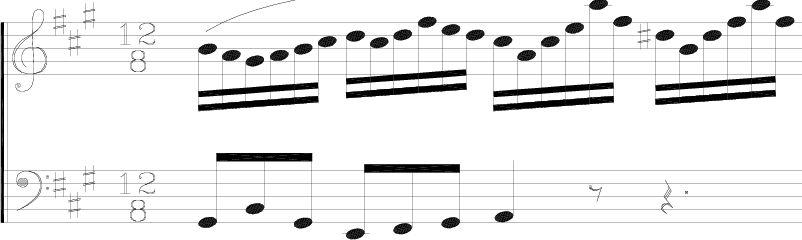
As an illustration, consider an excerpt from Bach’s Two-Part Invention No. 12, shown in figure 12. The time signature 12/8 has a subgrouping structure that divides the bar into two halves each of which has two beats. The right keyboard hand further divides the beat by three, and the left hand creates an additional division by two. Thus the full metrical structure is given by the following wreath product.