|
An additional advance came when a number of researchers independently started to use groups to structure the rules (Babbit, 1961; Leyton, 1974; Greeno and Simon, 1974). The major school for the use of group theory in music has become that of Guerino Mazzola in Switzerland: Mazzola (1990), Mazzola (1993-1996), Mazzola (2002). See also Noll (1995), Noll (1997). We argue that, when one examines the hierarchical theory of Restle, one must conclude that the human mind is maximizing transfer. That is, The process of sequence comprehension or generation is a process of transferring previous structure onto future structure. The fact that the mind tries to maximize this can be seen by the psychological studies carried out by Restle to support his hierarchical rules - e.g., profiles of anticipation errors showed that subjects were mapping previous structure onto the anticipated structure (Restle, 1970a). Our generative theory of shape says that this is best modelled by wreath products. We proceed as follows: Let us call a group generated by a set of compositional operators, a rule group 
Observe that, with the three operators defined by Restle, the group is iso-regular. Therefore, we now see that both the metrical and melodic structures, in their basic forms, are given by iso-regular groups. This supports our claim that origin states are given by iso-regular groups and that the subsequent generative process is symmetry-breaking by breaking the iso-regularity. Now according to our generative theory of shape, complex structure is created by unfolding, which is selection plus misalignment. One loads a set of iso-regular groups into the alignment kernel. These will represent the strict metrical or melodic anticipation hierarchies of Restle. |
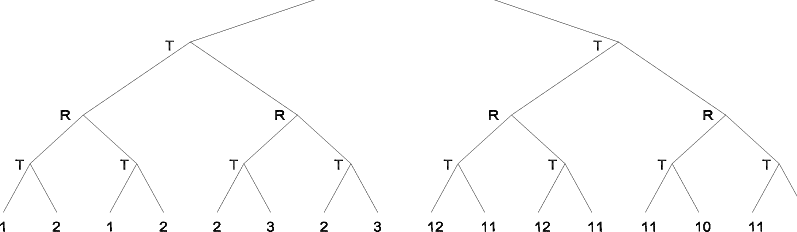
 . Given a hierarchy of the type shown in figure
  . Now assign a rule group to each node. Within any level
  , the nodes should each receive the
  . We argue that the rule-structure of the hierarchy is given by taking the wreath product of the groups
  , thus: